
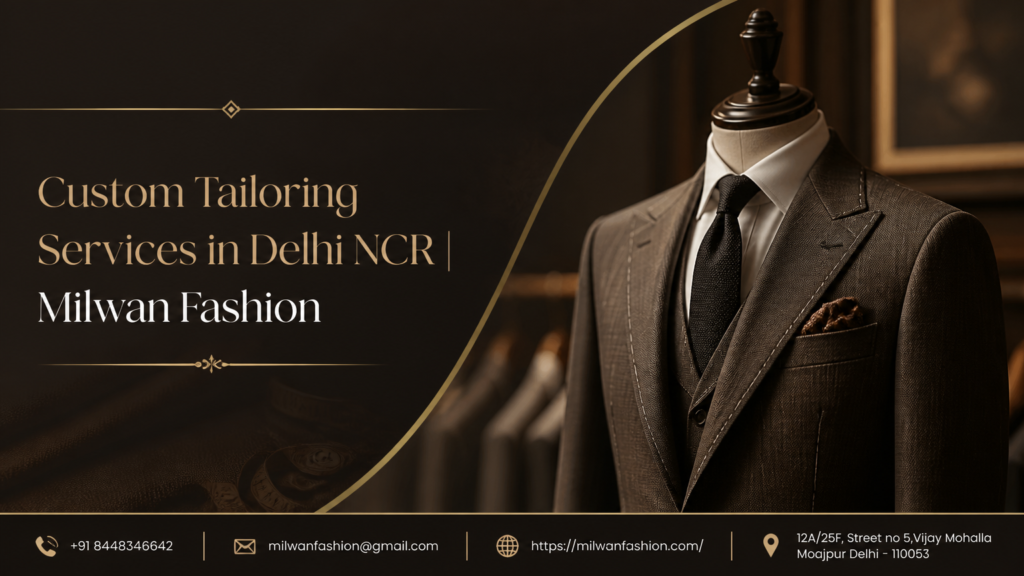
Searching for reliable custom tailoring services in Delhi NCR can feel overwhelming. Between informal neighborhood tailors, premium designer boutiques, and new doorstep apps, every option promises the perfect fit — yet the experience, the pricing, and the craftsmanship can vary wildly. Add wedding-season demand, fabric confusion, and confusing turnaround times, and most buyers end up settling instead of choosing with confidence.
This 2026 guide breaks down exactly how custom tailoring works in India, what you should pay across city tiers, how to vet a tailor, and where Delhi NCR fits into the country’s booming bespoke market. By the end, you’ll know which service model — doorstep, virtual, or in-store — fits your occasion, timeline, and budget.
TL;DR / Quick Answer
Custom tailoring services in India fall into three tiers: bespoke (fully hand-cut and patterned), made-to-measure (factory pattern adjusted to your measurements), and alteration (reshaping existing garments). Delhi NCR is India’s largest made-to-measure cluster, holding roughly 29% of the national market. Standard turnaround is 8–12 days, with express 48–72 hour options available from premium providers. Expect to pay ₹750 for a bespoke shirt, ₹6,500 for a two-piece suit, and ₹8,500 for a custom sherwani.
Table of Contents
- What is Custom Tailoring? Bespoke, Made-to-Measure, and Alteration Explained
- Custom Tailoring Services in India: City-Wise Directory
- The Custom Tailoring Process: From Consultation to Final Fitting
- Custom Tailoring Pricing in India: Complete Breakdown
- How to Choose the Best Custom Tailor: A 10-Point Checklist
- Doorstep vs Video vs In-Store Tailoring: Which is Right for You?
- Common Fit Problems and How Custom Tailors Solve Them
- Red Flags to Watch Out for When Hiring a Tailor
- Conclusion
- FAQs on Custom Tailoring Services
What is Custom Tailoring? Bespoke, Made-to-Measure, and Alteration Explained
Not every “custom” service is the same, and the difference matters for fit, price, and timeline. Bespoke is the highest tier: a master tailor drafts a fresh paper pattern from scratch using 20–30 body measurements, cuts the fabric by hand, and builds a structured garment (chest canvas, lapel roll, sleeve pitch) over multiple fittings. It is the gold standard for suits, tuxedos, and bridal wear, and typically takes 4–8 weeks.
Made-to-measure (MTM) sits in the middle. A base block pattern is adjusted to your measurements rather than drafted anew. MTM is faster (1–3 weeks), more affordable, and is what most organized Milwan Fashion-style providers deliver — including bespoke-feeling suits, shirts, and sherwanis that use Italian wool blends, premium matka silk, and rich velvets. Alteration simply reshapes an existing garment you already own; it is not custom tailoring, though it is sometimes bundled into the same booking.
India’s broader apparel data makes the scale of the segment clear: the custom apparel market is on track to more than double from USD 48.83 million in 2024 to USD 107.46 million by 2032 at a 10.36% CAGR, with metros like Mumbai, Delhi, and Bengaluru driving roughly 45% of that demand, according to Credence Research. Choosing the right tier is the first step toward a garment that actually fits your body, occasion, and budget.
Custom Tailoring Services in India: City-Wise Directory
Where you live shapes what you’ll pay and how quickly you’ll get your garment. Delhi NCR is the country’s largest made-to-measure cluster — North India holds around 29% of the national customized menswear market, supported by wedding expenditure and luxury spending, per DFU Publications. Mumbai and Bengaluru follow with strong corporate and wedding demand, while Hyderabad and Chennai anchor South India’s bridal couture segment.
In Delhi NCR specifically, organized providers now offer full doorstep service. A reputable custom tailor in Delhi, custom tailor in Gurgaon, and custom tailor in Noida can typically visit your home within 24–48 hours, take 20+ measurements, and deliver in 8–12 days. Tier-2 cities generally run 15–25% cheaper than metros, but selection, fabric access, and hand-embroidery expertise are noticeably thinner.
International and NRI clients are increasingly served through virtual e-designer consultations — a model that delivers expert guidance via video measurement and global courier, removing geography as a barrier. For most urban buyers today, the practical question is less “which city?” and more “which service model and which tailor within reach?”
The Custom Tailoring Process: From Consultation to Final Fitting
A professional custom tailoring service follows a predictable six-step workflow. Step one is the consultation, where the tailor or designer discusses the occasion, silhouette, fabric, color, and any embroidery or design details. This often happens at your doorstep or over a 30–45 minute video call, supported by digital swatches and sketches.
Step two is the measurement session. A senior master tailor records 20–30 body measurements — chest, shoulder slope, armhole, sleeve pitch, trouser break, and more — and analyzes posture and shoulder alignment. Step three is pattern drafting and fabric cutting, either by hand (bespoke) or by adjusting a base block (made-to-measure).
Step four is the first trial, usually on an interim or partially finished garment so the tailor can check balance, pull, and drop. Step five is embroidery and finishing — hand-work options like Zardozi, Resham, Aari, Sequins, Cutdana, and Moti are added here, often previewed through a digital mockup before stitching begins. Step six is the final fitting, pressing, and delivery, with one round of minor adjustments included.
Turnaround varies: 8–12 days for standard Delhi NCR orders and 48–72 hours for express service. Browsing custom suiting, shirting, and feminine wear collections in advance helps you arrive at the consultation with a clear direction and saves time.
Custom Tailoring Pricing in India: Complete Breakdown
Pricing for custom tailoring services in India varies by city, fabric, and complexity, but the following tiers reflect what buyers typically encounter from organized providers in 2026. Below is a reference table based on common garment categories.
| Garment | Metro Price (₹) | Tier-2 Price (₹) | Standard Turnaround |
|---|---|---|---|
| Bespoke Shirt | 750 – 1,400 | 500 – 900 | 5–8 days |
| Custom Trouser | 1,050 – 1,800 | 700 – 1,200 | 5–8 days |
| Two-Piece Suit | 6,500 – 14,000 | 5,000 – 10,000 | 10–15 days |
| Three-Piece Suit | 7,800 – 18,000 | 6,000 – 13,000 | 12–18 days |
| Tuxedo | 6,800 – 22,000 | 5,500 – 16,000 | 15–20 days |
| Sherwani | 8,500 – 25,000+ | 6,500 – 18,000 | 15–25 days |
| Kurta Pyjama | 1,300 – 2,500 | 900 – 1,800 | 5–8 days |
| Hand Embroidery (per motif) | Dynamic | Dynamic | +3–7 days |
The above ranges assume mid-grade fabrics; Italian wool blends, premium matka silk, and rich velvets push prices higher. Hand embroidery — Zardozi, Resham, Aari, Sequins, Cutdana, and Moti — is typically priced dynamically based on design complexity, motif density, and stitching hours. According to Deep Market Insights, India’s tailoring and alteration services market is projected to grow from USD 306.56 million in 2025 to USD 467.85 million by 2034, with custom suits specifically expanding at a 5.91% CAGR — clear evidence that the premium custom tier is still scaling fast.
How to Choose the Best Custom Tailor: A 10-Point Checklist
A great tailor is part craftsman, part designer, part project manager. Use this checklist to evaluate any custom tailoring service before booking.
- Heritage and experience — Look for proven track records, ideally multi-generational expertise, not just a social media page.
- Measurement depth — A serious tailor takes 20+ measurements, not just chest, waist, and length.
- Fabric transparency — Ask whether fabric is sourced by the tailor, supplied by you, or both (hybrid model).
- Trial fittings — At least one interim trial should be standard, not optional.
- Embroidery preview — Hand-work pieces should come with digital mockups before stitching begins.
- Turnaround clarity — Get a written timeline and an express option for urgent dates.
- Reviews and ratings — Verified ratings of 4.8/5 or higher on platforms like WeddingWire or Justdial are a strong signal.
- Service model fit — Doorstep, in-store, or virtual — pick what matches your schedule and location.
- Alteration policy — Confirm post-delivery adjustment support before paying.
- Price transparency — A clear rate card beats vague “starting from” quotes every time.
Providers built on four generations of tailoring expertise tend to check nearly every box above by default, which is why heritage matters when fit and trust are non-negotiable.
Doorstep vs Video vs In-Store Tailoring: Which is Right for You?
Each service model has real strengths. Doorstep tailoring is the most popular in Delhi NCR because it removes travel friction — the tailor comes to your home or office, takes measurements in your own environment, and handles the trial and final delivery on-site. It is ideal for busy professionals, wedding families, and anyone coordinating multiple garments.
Video or virtual tailoring is the right choice for NRI clients, outstation buyers, or anyone who cannot host a home visit. The provider guides you through self-measurement over video, reviews photos for shoulder slope and posture, and ships the finished garment by insured courier. Accuracy has improved markedly in recent years, though in-person measurements remain the gold standard.
In-store tailoring still works for buyers who want to touch fabrics, browse swatches in person, and try on sample pieces. It is also the safest choice for very complex couture, bridal lehengas, and heavily embroidered pieces where physical fabric handling matters.
A useful rule of thumb: if your garment is a shirt, trouser, basic suit, or sherwani with standard embroidery, doorstep or virtual is fast and reliable. If your garment involves intricate hand-work or couture-level detailing, an in-store appointment combined with a home trial is the safest bet. For helpful reading on choosing between models, browse tailored tailoring guides and fashion tips.
Common Fit Problems and How Custom Tailors Solve Them
Off-the-rack clothing fails on predictable points: shoulder drop, sleeve pitch, trouser break, chest pulling, and waist gap on women’s kurtas and blouses. Each of these has a specific cause — wrong shoulder slope, wrong armhole depth, wrong rise, insufficient ease, and a generic block pattern — and each can be engineered out through proper measurement and pattern adjustment.
A trained custom tailor will measure shoulder slope from the spine to the shoulder tip, set the armhole at the correct depth, balance the chest canvas to eliminate pull, adjust trouser rise and break for your height and shoe choice, and draft a women’s block based on bust, shoulder, and waist relationship rather than a unisex size. Women’s custom tailoring in particular — blouses, kurtas, lehengas, indo-western sets — remains underserved by most organized players, which is why fit issues in this category are so common.
Sustainability and fabric sourcing also matter. Buying made-to-measure reduces garment returns, which according to industry research cuts the waste associated with mass-produced fashion. A good tailor will also explain where fabrics come from, suggest climate-appropriate weights, and recommend blends that last longer. Solving fit problems is ultimately about choosing a tailor who measures deeply, drafts accurately, and stands behind the finished garment.
Red Flags to Watch Out for When Hiring a Tailor
Even in a market as large as India’s, a few warning signs should make you pause before booking. The first is vague pricing — “starting from” quotes with no breakdown of fabric, labor, and embroidery are a sign of future billing surprises. The second is no trial fitting — any tailor who refuses an interim trial before final delivery is cutting corners on fit.
A third red flag is refusal to share fabric details or sourcing information. If the tailor cannot tell you the origin, weight, or composition of the cloth, walk away. A fourth is no written timeline — verbal promises of “one week” without a confirmed delivery date often stretch into three.
Fifth, watch out for no reviews or unverifiable testimonials. In a country with nearly 12 million custom tailors, of whom roughly 99% operate informally according to Data For India citing the PLFS 2023–2024 survey, verified platform reviews are a meaningful trust signal. Sixth, pressure for full upfront payment before measurements or fabric selection is risky — most reputable providers accept a partial advance with balance on delivery.
Seventh, lack of alteration policy. A serious tailor commits to post-delivery adjustments; one who delivers and disappears is not offering true custom service. If you see two or more of these signs, look elsewhere — even in Delhi NCR’s crowded market, organized providers with transparent processes are easy to find.
Conclusion
Custom tailoring services in India in 2026 are no longer a luxury reserved for special occasions. With Delhi NCR commanding nearly 29% of the national made-to-measure market, doorstep and virtual models expanding fast, and pricing more transparent than ever, getting a garment that truly fits your body, occasion, and budget has become genuinely accessible. The formula is straightforward: choose the right tier (bespoke, made-to-measure, or alteration), match the service model to your schedule, and vet your tailor against a clear checklist. If you are ready to experience four-generation expertise, doorstep convenience, and structured quality control, book an appointment with Milwan Fashion today and let an expert tailor come to your door.
FAQs on Custom Tailoring Services
1. What are custom tailoring services and how do they differ from regular tailoring?
Custom tailoring services involve designing and stitching garments from scratch based on your individual measurements, body shape, and style preferences, rather than altering ready-made sizes. Unlike regular tailoring, custom services include pattern drafting, multiple trials, and fabric selection.
2. How much do custom tailoring services cost in Delhi NCR in 2026?
In Delhi NCR, custom tailoring services typically range from ₹750 for a bespoke shirt to ₹8,500+ for a custom sherwani. Two-piece suits start around ₹6,500 and three-piece suits around ₹7,800, with prices rising for premium fabrics like Italian wool blends or rich velvets.
3. How long does a custom tailoring order take in Delhi NCR?
Standard custom tailoring orders in Delhi NCR take 8–12 days from doorstep measurement to final delivery. Express service is available from premium providers and delivers in 48–72 hours for urgent orders like travel or last-minute events.
4. Are doorstep custom tailoring services reliable for suits and sherwanis?
Yes. Doorstep custom tailoring is now the dominant service model in Delhi NCR because senior master tailors can take 20+ measurements accurately in your own environment, followed by an interim trial at home. Verified providers maintain 4.8–4.9/5 ratings on platforms like WeddingWire and Justdial.
5. What is the difference between bespoke and made-to-measure tailoring?
Bespoke tailoring involves drafting a fresh pattern from scratch using your unique measurements and typically includes multiple fittings over 4–8 weeks. Made-to-measure adjusts a base block pattern to your measurements and delivers in 1–3 weeks, offering a bespoke feel at a more accessible price.
6. Can NRI or international clients use Indian custom tailoring services?
Yes. Most organized Indian custom tailoring services now offer virtual e-designer consultations via video, with guided self-measurement, photo verification, and global doorstep delivery by insured courier — a model designed specifically for NRI and international clients.
7. Which fabrics work best for custom tailored suits and sherwanis?
For suits, Italian wool blends and structure-retaining synthetics deliver the best drape and longevity. For sherwanis and ethnic wear, premium matka silk, raw silks, and rich velvets are preferred, especially when paired with hand-embroidery like Zardozi, Resham, or Aari.
8. How do I verify the quality of a custom tailor before booking?
Check verified ratings on platforms like WeddingWire and Justdial, ask for client testimonials with photos, request a written price breakdown and timeline, and confirm an alteration or post-delivery adjustment policy before placing your order.